


.png)



.svg)
AI? Agents? Workflow Automations?
We got you covered!
The central question of 2026 is no longer whether to leverage AI and build internal tech stacks, but where to focus to drive real alpha. This report has mapped 345 Data Driven VC firms and the top 100 thought leaders across the globe to provide the most important insights and tangible steps to become more data-driven.
Access the full report
Join our free community to access the 2026 Landscape Report

Chapter 1
The Why
Not every investor is data-driven. DDVCs build what others can't buy: proprietary workflows, data pipelines, and automation that systematically expand coverage and generate alpha.
Traditional investors are capped by network, anchored in personal experience, and lose their edge whenever a partner leaves. Data Driven Investors instead achieve comprehensive coverage through systematic data collection, filter opportunities with algorithms, and free up capacity for higher-value decision-making.

Firms build for two distinct reasons: 61% build for effectiveness (generating alpha, finding opportunities others can't see) while 39% build for efficiency (scaling operations, freeing up partner time). Within the DDVC universe, two archetypes have emerged: Workflow Builders (42%) - lean teams without dedicated engineers who stitch together off-the-shelf tools — and Fullstack Builders (58%) - firms with in-house engineering teams building proprietary, deeply integrated infrastructure
Chapter 2
The Past & Evolution

The VC digitization journey runs through five stages:
Old-school VCs rely on manual workflows and legacy tools.
Productivity VCs adopt off-the-shelf tools to streamline tasks.
Workflow VCs build their own automations without engineers.
Fullstack VCs build data infrastructure and internal tech stacks with engineers.
Quant VCs create fully autonomous funds that invest on autopilot with AI agents.
The model mix has shifted sharply.
In 2024, 86% of DDVCs were "Augmented" (human-led, AI-supported) and 14% "Quant."
By 2026, the split has reorganized entirely: 61% Augmented, 39% Agentic (AI-led, human-in-the-loop) — and the standalone Quant category has effectively disappeared as agentic workflows absorbed it.
Chapter 3
The Status Quo & How
The median DDVC runs $500M AUM with 15 employees and 1 engineer. Fullstack firms skew larger ($800M AUM, 23 employees, 2 engineers) than Workflow firms ($151M AUM, 7 employees, typically no dedicated engineer) - but both maintain roughly one engineer for every five investors, a ratio holding steady regardless of fund size.
Venture capital is evolving along a clear technological spectrum. We identified 345 DDVCs in 2026, up from 235 in 2025, 190 in 2024, and 151 in 2023.

Hiring is tilting toward engineering: 49% of DDVCs plan to hire one or more engineers in the next year, versus just 2% adding junior investors (45% plan to cut those roles). Budgets have followed suit, with engineering HR spend vs. Data/Tools/Tokens spend moving from 2:1 in 2025 to roughly 1:1 in 2026.
Becoming more data-driven in VC offers a clear edge - but the how matters just as much as the why. That's why we've mapped the actual tech stack DDVCs are building with: featured and most-used tools across data, CRM & portfolio management, productivity, agents & automations, and infrastructure - alongside AI spend benchmarks and a worked token-budget framework to help you start, or scale, your journey as a Data Driven VC.
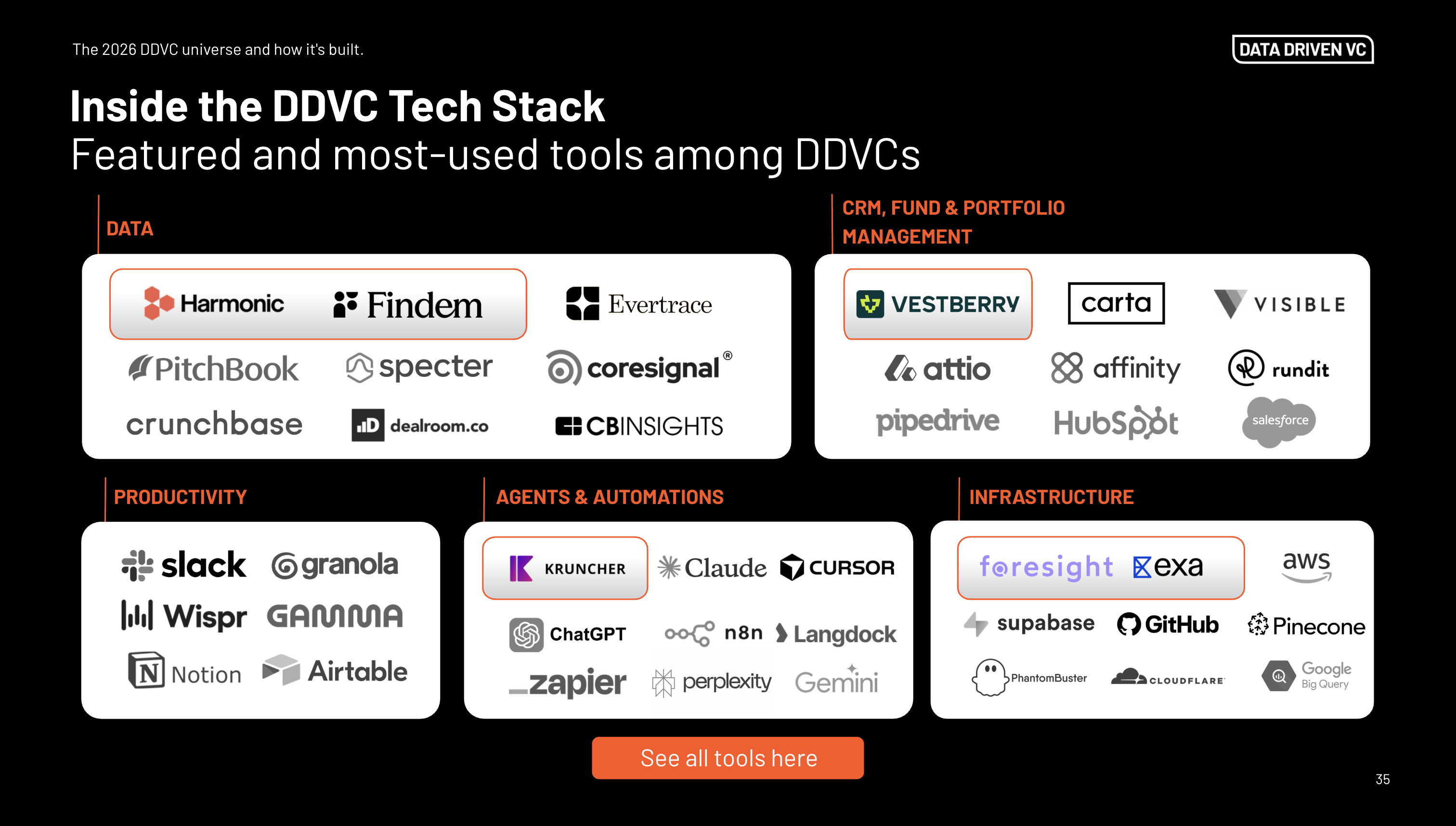
Adoption is accelerating - 57% of DDVCs are now "ramping up" internal tools, up from 37% in 2025.
By function, Investment Sourcing & DD (3.4/5) and Engineering (3.3/5) lead adoption, while Legal & Compliance lags (1.8/5). Claude is the most-used AI chatbot among DDVCs (90.5%), ahead of ChatGPT (73.3%) and Gemini (56.2%).
The real bottleneck isn't technology - it's capacity. 49% cite time & bandwidth as their top challenge, ahead of data quality (41%).
Find much more about what the leading DDVCs in the space are doing in the report and make sure you are included in the next Data Driven VC Landscape Report.

Chapter 4
The Future
For the first time, engineering teams are expected to grow faster than investment teams, as firms automate work traditionally handled by analysts and associates.
DDVCs are also resetting expectations: 72% now place "AI in VC" before the trough of disillusionment on the hype cycle, up from 55% in 2025 - a shift tied to the rise of agentic tooling and a widening builder base. Still, less than a third believe AI in VC has reached the Slope of Enlightenment, and 0% place it at the Plateau of Productivity.

Our 2026+ predictions:
- Agentic workflows become standard infrastructure — agentic VC has moved from concept to category.
- Engineering density becomes a hiring imperative — 49% plan to hire an engineer next, overtaking investor hiring at scale.
- Investors become the builders in a low-code world — in most Workflow Builder firms, investors and GPs own the stack directly.
- Legal & Compliance becomes the next adoption frontier — it scores lowest of any function today, making it the segment most likely to see rapid change.
Find our detailed predictions for 2026 and beyond in the report, where we dive into the rise of agentic infrastructure, the engineering-vs-investor hiring shift, and the Make vs Buy debate as low-code puts building within reach of every investor.
Chapter 5
Where to Learn More
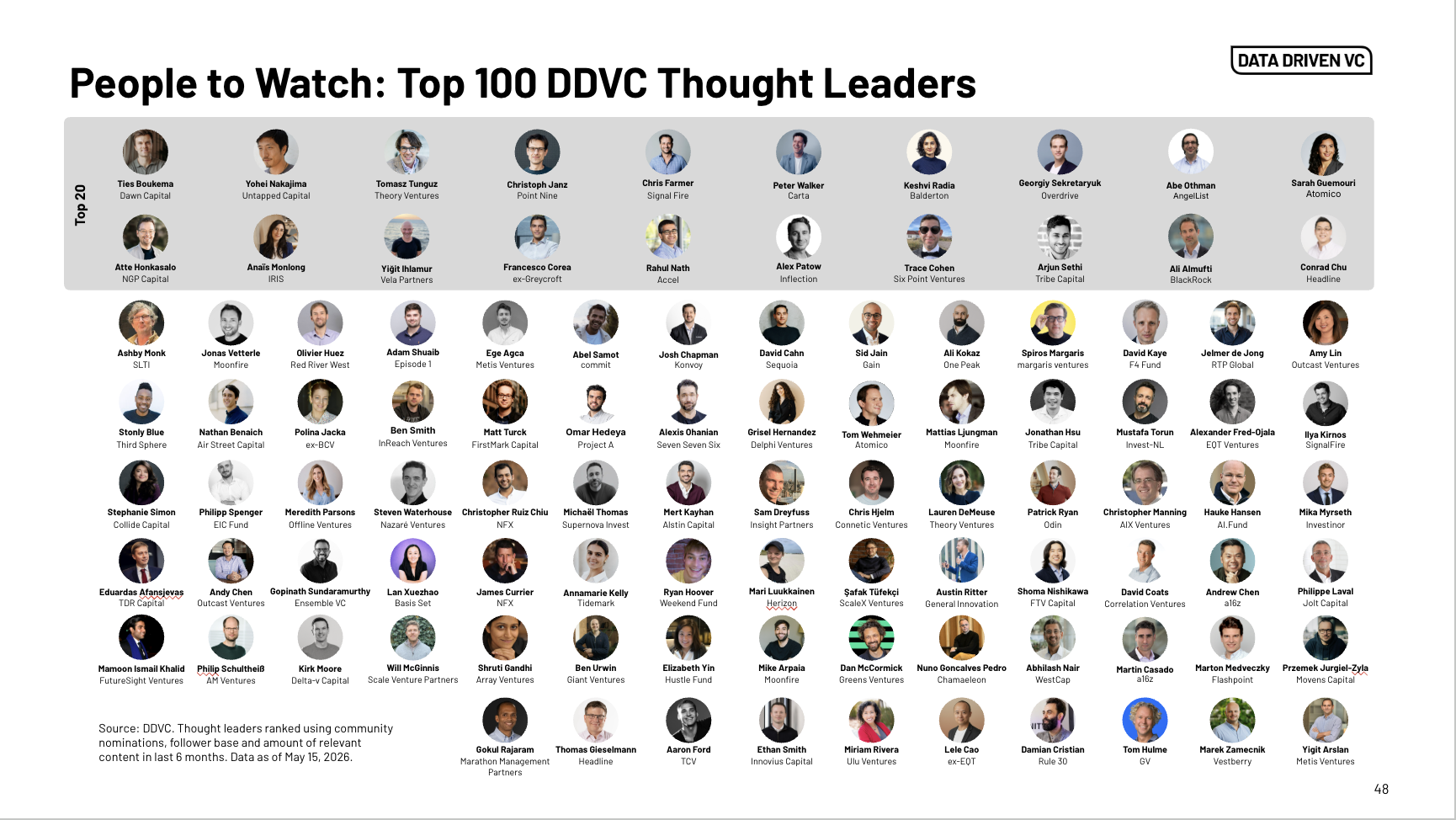
To inspire and guide that journey, we're also spotlighting the Top 100 thought leaders driving innovation in this space. These are the people challenging legacy thinking, building modern stacks, and leading the charge toward a more efficient, effective, and inclusive future of venture.
Conclusion
Last year's report made the case that data-driven investing works. That firms building their own workflows could move faster and dig deeper than those that weren't.
That case is closed.
345 firms are doing this now, up from 151 three years ago. The productivity shift is structural. A year ago, investors scaled at nearly double the rate of engineering teams. This year, that gap has closed.
What stood out to me most was the split between two ways of getting there.
Workflow Builders are getting real deal coverage with a handful of agents and zero engineers.
Fullstack Builders are spending years wiring proprietary data and infrastructure into everything from sourcing to LP reporting.
Both are working. Neither camp is waiting around, and I don't think there's a correct answer yet.
The finding that surprised me most: tooling is no longer the constraint.
Half of the DDVCs we surveyed said their biggest bottleneck is time and bandwidth. Those generating real alpha found the hours to wire those tools into how they source deals, run diligence, and report to LPs every week.
That's the real story this year.
Investors are turning into builders. That shift is making them measurably more productive. Agentic workflows are no longer the exception. They're becoming the default for a growing share of the industry.
So here's the question for you: which kind of builder are you going to be?
This report is our best look at who's doing that rebuilding and how. Use it to figure out where you sit, then go build.
Stay driven,
Andre
Access the full report